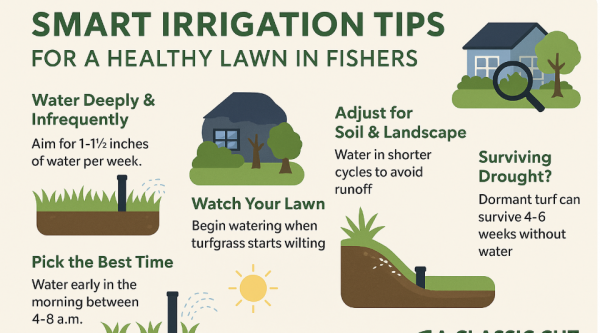
A healthy lawn in our area starts with proper watering, and Purdue’s “Irrigation Practices for Homelawns” has expert recommendations tailored to Hoosier conditions (extension.purdue.edu). Here’s how you can use them to your advantage:
1. Water Deeply & Infrequently
Aim for 1–1½ inches of water per week, depending on weather and soil type (extension.purdue.edu).
Better to soak the soil deeply in one long session or two sessions 3–4 days apart, rather than light sprinkling every day (extension.purdue.edu).
Deep watering encourages roots to grow downward—making your lawn more drought-resistant.
2. Watch Your Lawn—Don’t Just Rely on a Schedule
Begin watering only when you notice signs of stress, such as a blue-gray tint or footprints that don’t spring back (turf.purdue.edu, extension.purdue.edu).
Turfgrass handles mild stress well, but if plants start wilting, it’s time to water right away (extension.purdue.edu).
Automatic sprinklers? Run one cycle, then reassess—don’t just follow a rigid weekly routine (blueducklawncare.com).
3. Pick the Best Time of Day
Ideal watering time is early morning (4–8 a.m.)—this reduces evaporation and ensures better water penetration .
If morning isn’t possible, go for mid-morning (8 a.m.–noon).
Avoid late evening watering to reduce disease risk (turf.purdue.edu).
4. Adjust for Your Soil & Landscape
If your lawn has areas with compacted soil or slopes, water in short bursts: avoid runoff by pausing when water starts to flow, letting it soak in, then resuming (extension.purdue.edu).
Sandy soil needs more frequent, shorter watering since it drains faster .
5. Helping New Grass Establish
Seeded areas: keep the top inch of soil moist with several light waterings 2–4 times daily until seedlings grow 1–2 inches tall .
New sod: water once or twice daily, ensuring moisture goes through the sod and into the soil—overwatering can prevent proper root growth (extension.purdue.edu).
6. Surviving Drought?
If your lawn goes brown and dormant, don’t panic—it’s alive! Dormant turf can survive 4–6 weeks without thinning (extension.purdue.edu).
For dormancy survival, water 1–1½ inches every 4–6 weeks until normal conditions return (extension.purdue.edu).
📊 Quick Watering Check-List
Task Recommendation Weekly water needed 1–1½ inches Best watering times 4–8 a.m. or 8 a.m.–noon Watering frequency Deep & infrequent Soil/landscape notes Adjust for slopes, compaction, sandy soils
Why These Tips Matter in Fishers
Hoosier summers can be hot and dry—but overwatering does more harm than good, leading to shallow roots, disease, and higher bills.
Following Purdue’s guidance helps build a resilient lawn that can bounce back from heat and drought.
Final Thoughts
Water wisely, not just often. Pay attention to your lawn’s signals, time your irrigation smartly, and adjust based on soil and weather. Your Fishers lawn will reward you with deeper roots, healthier blades, and a lush, emerald appearance.
Need help setting up or tweaking your irrigation system? We offer irrigation installation and maintenance, and we’re happy to help!
317-721-7669

💧 Smart Irrigation Tips for Fishers Area Lawns
💧 Smart Irrigation Tips for Fishers Area Lawns
Tags: